




Join our Telegram group and receive breaking and trending news updates directly on your phone.
Join for News Updates ✕


By Dada Ahmed.
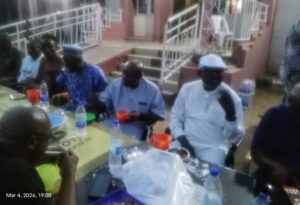
On a calm, peaceful, and untroubled Wednesday evening of March 4, 2026, after a scorching sun, the premises of the Nigeria Union of Journalists (NUJ) Press Centre in Lokoja returned to a reflective mood.
The fading sun cast a golden hue across the courtyard as journalists,Muslim and Christian alike,exchanged warm greetings and quiet laughter while the Muslims among them waited for the call to break the fast.
Plates of dates, pap, akara, and bottled water were neatly arranged on tables.
Conversations flowed gently. It was an atmosphere of peace, shared jokes, mutual respect, and shared humanity among members of the fourth estate of the realm and friends.
The gathering was for iftar, the evening meal with which Muslims end their daily fast during the holy month of Ramadan.
Care was taken to ensure that the meal served,pap, akara, dates (debino), and suga and jollof rice as takeaway ,aligned with Islamic dietary guidelines, reinforcing the spirit of consideration and respect that defined the gathering.
In Islam, fasting from dawn to sunset is one of the Five Pillars of the faith, teaching discipline, sacrifice, empathy for the less privileged, and spiritual reflection.
Iftar is not merely about eating; it is a moment of gratitude, prayer, and fellowship.
On this particular evening, however, it also became a powerful symbol of unity beyond religious boundaries and the oneness of human beings before the Supreme Being.
Ironically, religion, ordained to guide humanity towards peace and moral uprightness, has often deepened fault lines in the world, Nigeria inclusive. From sectarian crises to the political manipulation of faith identities, differences in belief have sometimes overshadowed shared citizenship. Suspicion and mistrust have, at various times, eroded social cohesion and slowed national development.
Yet, in the midst of this global narrative, journalists in Kogi State appear determined to write a different story.
Since the creation of Kogi State on August 27, 1991, from parts of Benue and Kwara states, members of the Kogi State Council of the NUJ have consciously nurtured religious harmony within their fold. In a profession often tasked with reporting divisions, they have chosen internally to model unity.
The March 4 iftar was organised by one of the respected members of the council, the immediate past Permanent Secretary in the Kogi State Ministry of Information and Communications and now Technical Assistant to the ministry, Mr. Ebenezer Adurodija, who is a Christian.
He said his gesture was simple yet profound, basically aimed at hosting his Muslim colleagues in the spirit of Ramadan solidarity.
To many journalists who witnessed the occasion, this was nothing short of the truth because the event was not an act of tokenism but one of genuine fraternity.
That a Christian would organise iftar for Muslims speaks volumes about the depth of interfaith understanding among journalists in Kogi State. It reflects a maturity that places shared humanity above sectarian labels and professional brotherhood above religious boundaries.
Besides the fact that Islam accepts such a gesture, according to Muslim clerics citing verses in the Holy Quran, the event demonstrates that faith need not be a barrier to fellowship. Rather, it can serve as a bridge when approached with sincerity and mutual respect.
More so, the significance of the event lay not merely in the sharing of food but in the sharing of values,a gesture that promotes goodwill, mutual respect, and peaceful coexistence. These are values strongly encouraged in Islam and equally upheld in Christianity. It is a practical demonstration that both religions preach love, compassion, and generosity, according to Mal. Yahaya Mohammed.
He described journalists as society’s watchdogs and agenda-setters.
“They educate, inform, and entertain. When those entrusted with shaping public opinion and discourse embody unity, they subtly transmit that ethos to the wider society to boost religious tolerance and peace. Their conduct becomes a silent editorial, more powerful than headlines,” Mohammed stressed.
Kogi, often described as Nigeria’s Confluence State because it hosts the meeting point of Rivers Niger and Benue, is naturally symbolic of convergence. The interfaith harmony displayed at the NUJ Press Centre mirrored this geographical identity. Just as the two great rivers merge without losing their essence and move together seamlessly, so too can diverse faiths coexist without conflict.
Moreover, the event reinforced professional solidarity, where journalism thrives on collaboration and trust.
The wisdom here is that when colleagues understand and respect one another’s religious practices, workplace tensions reduce and productivity improves.
The iftar created space for dialogue, laughter, and deeper bonds beyond deadlines and headlines, as demonstrated by members who attended the event.
Importantly, such a gesture counters the narrative that religion must divide. After all,it shows that harmony is not an abstract ideal but a deliberate practice. Harmony takes intentional acts,like attending one another’s celebrations, acknowledging sacred seasons, and offering support across faith lines,to build a culture of peace.
Therefore,other professional bodies can learn from this example. Lawyers, teachers, medical practitioners, civil servants, traders’ associations, forums, and other entities can adopt similar initiatives by organising interfaith gatherings, seminars on tolerance, or community outreach programmes that cut across religious identities.
Experience shows that unity does not grow by chance; it grows by design.
In a country as plural as Nigeria, national cohesion depends on everyday interactions. Grand political speeches alone cannot heal divisions. Rather, it is these modest, heartfelt acts that gradually reshape attitudes and dismantle prejudice.
For Kogi journalists, the March 4 iftar is also a reminder of their moral responsibility because as chroniclers of society, they wield influence.
It must be stressed that the simple evening event serves as a clarion call on journalists to ensure balanced reporting on religious matters, avoid inflammatory language, and promote stories that highlight cooperation rather than conflict, in order to further strengthen social harmony not just in Kogi but in Nigeria at large.
To the discerning minds, the March 4 gathering transcends a routine Ramadan observance. It represents a quiet statement that peaceful coexistence is possible, practical, and productive. It also affirms that shared professional identity can supersede sectarian differences.
Before the event concluded and journalists dispersed to their homes for evening prayers, the Vice president, NUJ Zone D, Alhaji Momojimoh Adeiza, and the Chairman of the council, Alhaji Seidu Adamu, showered praises on Adurodija for the historic gesture and prayed that God would bless him abundantly.
The basic lesson every soul that graced the evening event took home was that unity is built one table at a time, and that the unity of Nigeria is possible in spite of our religious diversity and other divisive expressions.
They cited such event as one of the windows of opportunity for all and sundry in Nigeria to cultivate the culture of peace , tolerate one another for the and promotion and development of Nigeria.
The hope is that if other sectors of Nigerian society can learn from the example set by an NUJ member in Kogi State, and elsewhere in Nigeria,the country will come to realise that its religious and cultural diversity is not a weakness but rather its greatest strength.
Ahmed, a member of NUJ in Kogi State and Editorial Advisor for the Guild of Interfaith Media Practitioners of Nigeria,GIMP-Nigeria,publishes The Reporters.