




Join our Telegram group and receive breaking and trending news updates directly on your phone.
Join for News Updates ✕


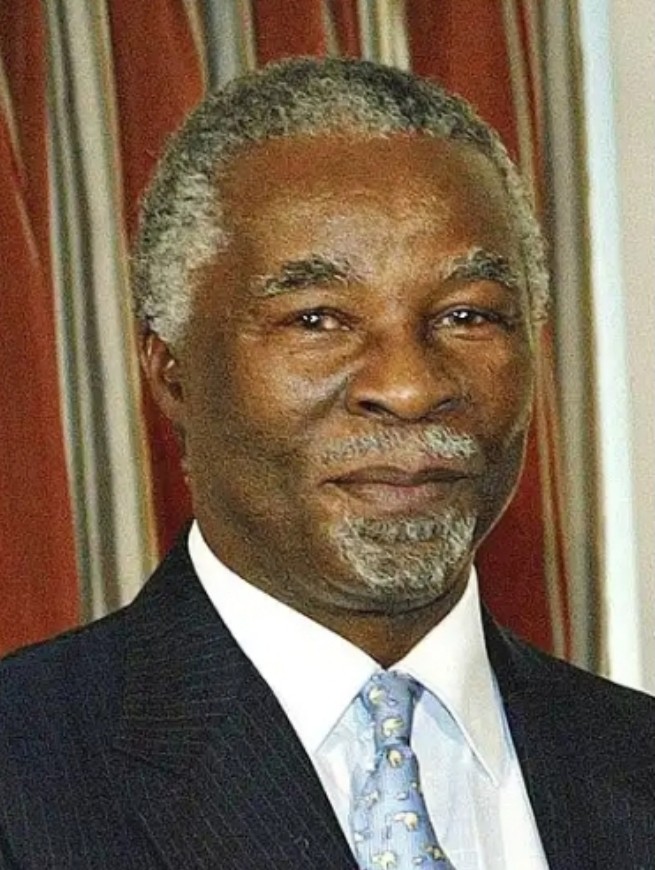
Former South African President, Thabo Mbeki has cried himself to death, through possible heart attack.
Information reaching us said that the 81 year old Mbeki was rushed to the hospital in the morning of yesterday, January 2, and was immediately pronounced dead by the doctors.
Mbeki’s family said that he had complained about his heart at dawn before being rushed to the hospital.
“We are in shock. He was full of life last night but this dawn, all that he could say was his heart and we rushed him to the hospital but couldn’t make it,” a close family member said.
ANC’s chieftain, Khusela Sangoni, said: ”The whole ANC are mourning. He was full of life days ago. He even talked to us about the LGE before we went to the polls. We are in total shock.”
Mbeki, who succeeded Nelson Mandela as President, was born to Govan Mbeki, a renowned ANC intellectual, on June 18, 1942. He served as President of South Africa for nine years as the second post-apartheid leader, taking over from the legend, the late Nelson Mandela, the first post-apartheid black President.
Late Mbeki was involved in ANC politics all the way from 1956, when he joined the ANC Youth League, and was a member of the party’s National Executive Committee since 1975. Born in the Transkei, he left South Africa at the age of twenty to attend university in England, and spent almost three decades in exile abroad, until the ANC was unbanned in 1990.
He rose through the organisation in its information and publicity section and as Oliver Tambo’s protégé, but he was also an experienced diplomat, serving as the ANC’s official representative in several of its African outposts. He was an early advocate for and leader of the diplomatic engagements which led to the negotiations to end apartheid. After South Africa’s first democratic elections in 1994, he was appointed national deputy president.
In subsequent years, it became apparent that he was Mandela’s chosen successor, and he was elected unopposed as ANC president in 1997, enabling his rise to the presidency as the ANC’s candidate in the 1999 elections.
While deputy president, Mbeki had been regarded as a steward of the government’s Growth, Employment and Redistribution policy, introduced in 1996, and as president, he continued to subscribe to relatively conservative, market-friendly macroeconomic policies. During his presidency, South Africa experienced falling public debt, a narrowing budget deficit, and consistent, moderate economic growth.
However, despite his retention of various social democratic programmes, and notable expansions to the black economic empowerment programme, critics often regarded Mbeki’s economic policies as neoliberal, with insufficient consideration for developmental and redistributive objectives. On these grounds, Mbeki grew increasingly alienated from the left wing of the ANC, and from the leaders of the ANC’s Tripartite Alliance partners, the Congress of South African Trade Unions and South African Communist Party. It was these leftist elements which supported Jacob Zuma over Mbeki in the political rivalry that erupted after Mbeki removed the latter from his post as deputy president in 2005.
As president, Mbeki had an apparent predilection for foreign policy and particularly for multilateralism. His Pan-Africanism and vision for an “African renaissance” are central parts of his political persona, and commentators suggest that he secured for South Africa a role in African and global politics that was disproportionate to the country’s size and historical influence.
He was the central architect of the New Partnership for Africa’s Development and, as the inaugural chairperson of the African Union, spearheaded the introduction of the African Peer Review Mechanism.
After the IBSA Dialogue Forum was launched in 2003, his government collaborated with India and Brazil to lobby for reforms at the United Nations, advocating for a stronger role for developing countries. Among South Africa’s various peacekeeping commitments during his presidency, Mbeki was the primary mediator in the conflict between ZANU-PF and the Zimbabwean opposition in the 2000s.
However, he was frequently criticised for his policy of “quiet diplomacy” in Zimbabwe, under which he refused to condemn Robert Mugabe’s regime or institute sanctions against it.
(C)Greenbarge Reporters.
Strategic Media Partnership for Growth and Reputation: Introducing The Reporters
The Reporters is a dynamic online news publication committed to delivering credible, timely, and impactful journalism across Nigeria and beyond. With a strong foundation in professional reporting and editorial integrity, the platform focuses on social, economic, political, and human development issues that shape public discourse. Backed by decades of journalistic experience, The Reporters offers a trusted voice that informs, educates, entertains, and influences a diverse and engaged audience.
For members of the business community, The Reporters provides a strategic platform to enhance visibility, build brand credibility, and connect with target markets. Through well-crafted news, features, interviews, sponsored content, and digital amplification, businesses can showcase their products, services, and innovations to a wider audience. This engagement not only drives patronage but also positions organisations as key contributors to economic growth and development.
Political actors and aspirants also stand to benefit significantly from partnering with The Reporters. As the 2027 elections approach, the platform offers an opportunity for politicians to effectively communicate their vision, programmes, and track records to the electorate. Through balanced profiling, issue-based coverage, and reputation management content, The Reporters helps shape public perception and strengthens candidates’ connection with voters.
Beyond visibility, The Reporters plays a crucial role in image laundering and perception management, presenting clients in a favourable, credible, and issue-driven light while maintaining ethical standards. By highlighting achievements, clarifying controversies, and projecting leadership qualities, the platform supports politicians in building trust and acceptance among constituents, which are critical assets in any electoral contest.
Engaging with The Reporters is therefore not just about publicity, it is about strategic communication for mutual benefit. Partners gain access to a credible media channel with the wide reach of The Reporters while it continues to fulfill its mandate of promoting development-oriented narratives. We invite stakeholders in both business and political spheres to collaborate with us in shaping informed opinions, driving growth, and advancing democratic engagement.
Prospective clients can reach us via WhatsApp: 08032901058 or email: ahmeddada008@gmail.com.
- Management