



Join our Telegram group and receive breaking and trending news updates directly on your phone.
Join for News Updates ✕


By Dada Ahmed.
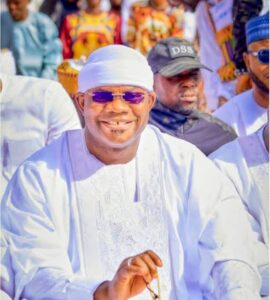
Alhaji Yahaya Adoza Bello.
Former Governor of Kogi State.
On January 27, 2016, at the Lokoja Township Stadium, history beckoned as Alhaji Yahaya Adoza Bello took the oath of office as the fourth democratically elected governor of Kogi State before an enthusiastic audience drawn from all strata of society in the Confluence State, created on August 27, 1991.
Young, unconventional, and stepping into office under dramatic political circumstances, Bello arrived with a burden of expectation and the curiosity that often accompanies new leadership.
Eight years later, many Kogites, especially his supporters,believe his tenure was defined by an ambitious drive to reposition the state through infrastructure renewal, institutional reforms, and people-centred governance.
That perception aligns with the core thrust of his inauguration speech, where he signed what he described as a social contract to lead the people of Kogi State.

The flyover at Ganaja junction, Lokoja,one of the legacy projects of the Bello administration.
Leadership scholar John C. Maxwell once observed that “a leader is one who knows the way, goes the way, and shows the way.”
For many of Bello’s supporters, this philosophy aptly captures his governing style,direct, hands-on, and often bold. His administration anchored its development strategy on five pillars: Education, Agriculture, Security, Inclusivity, and Revenue Generation. Rather than embark on episodic projects, the government pursued structured interventions aimed at creating long-term impact and measurable growth.
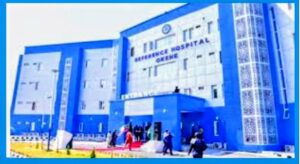
State -Of-Art Reference Hospital in Okene built his government.
Education became a signature sector of the administration. The establishment of the Confluence University of Science and Technology expanded access to science and technology education, while the creation of Kogi State University, Kabba, ensured that each senatorial district hosts a state-owned university.
At Prince Abubakar Audu University, Anyigba, and the Kogi State Polytechnic, Lokoja, and other state-owned educational institutions,infrastructural and academic upgrades were strengthened to boost institutional capacity.
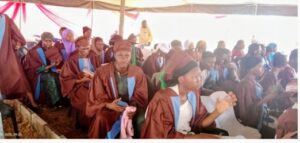
Matriculated Students of the newly established Confluence University of Science and Technology, Osara in 2025.
In his lecture titled “Ill-Health and Illiteracy: Siblings’ Alliance Against Development” delivered on November 28,2025 at the maiden convocation ceremony of the Confluence University of Science and Technology, Osara,former Ondo State Governor Dr. Olusegun Mimiko paid glowing tribute to the Bello administration for establishing the university.
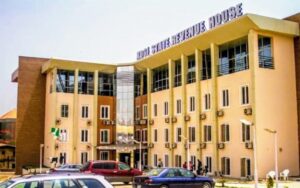
The Revenue House in Lokoja.
He said: “The Confluence University of Science and Technology, Osara, stands out as one of Nigeria’s most promising centres of innovation, scientific inquiry, and human capacity development.
“Established with a clear mandate to bridge critical gaps in science, the university has, in a remarkably short period, demonstrated uncommon vision and resilience.
“As a young and rapidly expanding institution, CUSTECH has embraced a distinct path anchored on academic excellence, technological relevance, and problem-oriented research.
“Beyond physical growth, the university is building a culture of discipline, merit, innovation, and community service.
“Its leadership has articulated a vision that resonates deeply with the developmental aspirations of Kogi State and Nigeria at large: to produce graduates who are not just employable but capable of creating solutions, enterprises, and pathways that uplift society.”
The recruitment of teachers for public secondary schools,one of the credits of the immediate past administration,further addressed manpower gaps, reinforcing Bello’s emphasis on human capital development as the bedrock of progress.
Experience shows that infrastructure development under Bello left visible imprints across the state. In Lokoja, projects such as the Ganaja Flyover Bridge,the first in Kogi’s history,the Muhammadu Buhari Civic Centre, the Kogi Revenue House, the GYB Model School in Adankolo, and the upgraded Specialist Hospital reshaped the capital’s skyline and boosted public service delivery.
Beyond Lokoja, the administration built a Reference Hospital in Okene, a state-of-the-art health facility described as one of the best in Nigeria,modernised general hospitals across the three senatorial districts of the state,constructed township and rural roads, and established the Omi Rice Processing Mill in Yagba West.
These initiatives reflected a deliberate attempt to spread development to the hinterland. For residents, the projects represent not abstract statistics but tangible improvements in mobility, healthcare access, and economic opportunity.
Economically, the administration strengthened internally generated revenue through tangible reforms at the Kogi State Internal Revenue Service (KGIRS), moving collections from modest monthly figures of millions in 2016 to significantly higher returns in subsequent years, running into billions annually. Trade facilitation, support for small and medium enterprises, and youth employment initiatives broadened participation in the state’s economy.
Analysts note that improved fiscal transparency and debt management earned the Bello administration recognition from the World Bank in areas of accountability and domestic revenue mobilisation,commendations supporters cite as validation of prudent financial stewardship.
Equally pronounced was Bello’s emphasis on security and institutional stability. Observers note that Kogi recorded relative peace during periods when insecurity challenged several states across the country. The administration also maintained stable academic calendars in state-owned tertiary institutions during nationwide disruptions, thereby enhancing learning continuity.
Idris Miliki Abdul, Executive Director of Conscience for Human Rights and Conflict Resolution (CHRCR), attributed the achievements of the immediate past administration to its resolve to re-energise the state’s security architecture through the purchase of vehicles for security agencies, as well as the employment and training of vigilantes across the state, among other measures.
Bello’s unconventional handling of the COVID-19 era, limited foreign travels, and prioritisation of local engagement projected the image of a governor focused more on domestic governance than ceremonial This is the view of a health expert in lokoja,Mr.Mathew Audu.
For Richard Elesho, a journalist based in Lokoja, perhaps the most socially transformative dimension of Bello’s tenure was his deliberate inclusion of women and youths in governance.
He noted that women occupied strategic positions, including Secretary to the Government of Kogi State, Dr. Folashade Ayoade Arike,who still holds the office as at the time of this feature article,March 3,2026,while young professionals were elevated across local councils and state agencies,a trend that continues under Governor Ahmed Usman Ododo.
Indeed, Bello ensured that all the 21 local government areas in the state had women serving as vice chairpersons, a move widely regarded as a pioneering step in Nigeria’s subnational governance landscape.
Political observers expressed the view that this gender- and youth-sensitive approach reshaped political participation in Kogi, redefining leadership as accessible rather than exclusive.
As Bello exited Lugard House in January 2024, assessments of his eight-year stewardship continued to generate debate, as is natural in democratic governance. Yet across communities, one narrative persists,that his administration altered Kogi’s development trajectory through visible infrastructure, educational expansion, fiscal reforms, and social inclusion.
Mal.Mohammed Baba Sadiq, a Senior Lecturer in the School of Preliminary Studies, Kogi State Polytechnic, Itakpe Campus, said of FGYB’s government:
“Former Governor of Kogi State, His Excellency Yahaya Adoza Bello’s eight-year tenure came as a thunderbolt of bravery to correct anomalies, and it was impactful on the citizenry of the three senatorial districts.
“Nevertheless, as a human being at the helm of the state government, he may have his shortcomings, acknowledging the fact that no human being or leader, as the case may be, is infallible.
“First and foremost, Bello gave credence to reform, facelifted the administrative structure, and streamlined the civil service for effective management and enhanced productivity, with visible impact in the state civil service.
“His thunderbolt-like bravery has added an enduring legacy of academic stability,‘No More Strike’,in tertiary institutions and other levels of education in the state.
“Closely related to this is the establishment of two operational state universities within a space of one year:CUSTECH, Osara, and KSU, Kabba. Kudos to the former governor, Yahaya Adoza Bello.”
In the final analysis, political observers argue that Bello’s legacy rests not merely on concrete structures but also on the institutions strengthened, opportunities expanded, and confidence restored in the possibility of purposeful governance in Kogi State.
Ultimately, the greatest legacy of the FGYB administration may well be measured by the human capacity it developed,an essential driver of social, economic, and political advancement in any society, Kogi State inclusive.
Dada Ahmed,a journalist and publisher,writes from Lokoja.
ahmeddada008@gmail.com.