




Join our Telegram group and receive breaking and trending news updates directly on your phone.
Join for News Updates ✕


By Correspondent in Abuja.
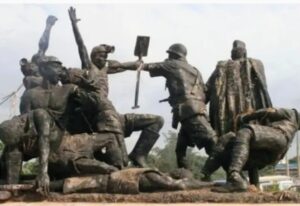
(C) BBC.
Prof. Yemi Akinseye-George (SAN),has called on the United Kingdom Government and other respondents to comply with the recent judgment of the Enugu State High Court on the 1949 Iva Valley Massacre.
Akinseye-George made the call on Friday while addressing a news conference in Abuja.
Our correspondent reports that on Feb. 5, the Enugu State High Court, presided over by Justice A.O. Onovo, delivered an 80-page landmark judgment on the killing of 21 unarmed coal miners at the Iva Valley Coal Mine, Enugu, on Nov. 18, 1949.
According to the Senior Advocate of Nigeria, the case was instituted by Mazi Onoh, a human rights activist on behalf of the families and dependants of the deceased miners.
The respondents in the suit include the Secretary of State for Foreign, Commonwealth and Development Affairs, British Government (represented in Nigeria by the British High Commissioner and the Foreign, Commonwealth.
Others are Development Office); the Federal Government of Nigeria; the Attorney-General of the Federation; and the Head of the Commonwealth Government of the United Kingdom (also represented in Nigeria by the British High Commissioner and the Foreign, Commonwealth and Development Office).
In its judgment, the court established that on Nov. 18, 1949, coal miners in Enugu were engaged in a protest over poor working conditions, wage disputes and discriminatory labour practices when colonial police officers, acting under the authority of the British colonial administration, opened fire on them.
Twenty-one miners were shot and killed.
At the time, Nigeria was not an independent sovereign state but was administered as a British colony. The coal mines were operated for commercial extraction and export under colonial control, and the victims were British colonial subjects.
Akinseye-George noted that the court observed that no effective judicial inquiry, criminal accountability, compensation, apology or redress followed the massacre, leaving the families of the victims without justice for over 75 years.
He described the judgment as the first formal judicial determination within Nigeria addressing the massacre and its legal consequences.
The SAN said the court held that sovereign immunity is not absolute, relying on Nigerian and comparative jurisprudence to conclude that serious allegations of grave human rights violations cannot be dismissed on technical immunity grounds.
He added that the court found that the case raised serious issues of unlawful deprivation of life requiring adjudication and affirmed that Section 46 of the 1999 Constitution grants High Courts jurisdiction to determine applications for the enforcement of fundamental rights.
The court made specific and enforceable orders, including monetary compensation and written apologies to be published in major Nigerian and British newspapers.
It awarded general damages against the 1st, 2nd, 5th and 6th respondents jointly and severally in the sum of £20 million in respect of each of the 21 victims.
The court held that the respondents were jointly and severally liable for the breach and violation of the right to life of the victims, describing the killings as unlawful, unconstitutional, unwarranted, unjustified, cruel and contrary to established legal protections.
According to Akinseye-George, the judgment does not merely revisit history but affirms present-day constitutional obligations.
He said the court ordered the Attorney-General of the Federation and relevant Nigerian authorities to formally initiate diplomatic engagement within 60 days and submit a detailed compliance report to the court within 90 days.
“This ensures that enforcement moves beyond symbolic declarations into concrete diplomatic action,” he said.
The SAN disclosed that the legal team had served the Certified True Copy of the judgment on all respondents and formally written to the Federal Government of Nigeria through the Attorney-General of the Federation.
He added that the British Government had also been notified through the office of the British High Commissioner in Nigeria, with a demand for compliance.
“As one of the world’s foremost proponents of the rule of law and human rights, the United Kingdom is expected to respect the decision of a competent Nigerian court and comply with its orders,” he said.
He described the judgment as justice for the 21 unarmed miners killed in 1949, recognition of 75 years of pain endured by their families, and a reaffirmation that the right to life is inviolable.
“The court of law has spoken. Justice has been declared. We now call for compliance,” he said.
Edited by Dada Ahmed.