




Join our Telegram group and receive breaking and trending news updates directly on your phone.
Join for News Updates ✕


By Dada Ahmed in Lokoja.
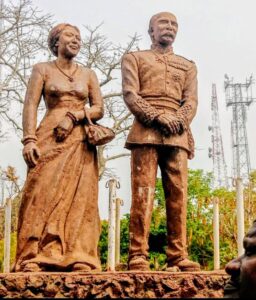
(C) The Reporters’ photo.
This statue of Lord Frederick Lugard, former Governor-General of Nigeria, stands alongside his wife, Flora Lugard located on Munti patti,a mountain of 1,500 feet above sea level in Lokoja.
It is one of the historic relics that highlight Lokoja as a notable tourism destination in Nigeria.
Lord Frederick Lugard (1858–1945) was a British colonial administrator whose policies profoundly shaped the political structure of modern Nigeria.
He began his colonial career in Africa in the late 19th century, serving with distinction in regions that now comprise Nigeria. In 1899, Lugard was appointed High Commissioner of the Protectorate of Northern Nigeria, where he implemented the system of indirect rule, governing through local emirs and traditional institutions.
This approach allowed the British to administer vast territories efficiently while maintaining a semblance of local authority, laying the groundwork for Nigeria’s administrative framework.
In 1912, Lugard became Governor of the Northern Nigeria Protectorate, further consolidating British control over the region.
His vision of unifying the diverse territories of Nigeria came to fruition in 1914, when he orchestrated the amalgamation of the Northern and Southern Protectorates, creating the Colony and Protectorate of Nigeria.
This unification, driven by economic and administrative considerations, marked a turning point in Nigeria’s history, bringing together over 250 ethnic groups under a single colonial government.
Lugard’s policies emphasized central authority while relying on local structures, a balance that influenced Nigerian governance for decades.
After the amalgamation, Lugard served as the first Governor-General of Nigeria from 1914 to 1919. During his tenure, he focused on developing infrastructure, establishing educational institutions, and consolidating British economic interests.
He also promoted native courts and local councils, which reinforced indirect rule as a lasting feature of Nigerian administration upto 1960 when Nigeria gained her independence on October 1,1960.