




By Correspondent in Abuja.
Avocats Sans Frontières (ASF) France, an international human rights organisation, has revealed that no fewer than 82 Nigerian women are currently on death row in correctional centres across the country.
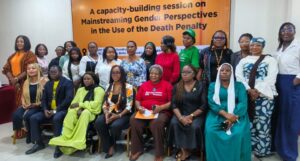
Angela Uzoma-Iwuchukwu, Country Director of ASF France in Nigeria, made this known on Wednesday during a capacity-building session on Mainstreaming Gender Perspective in the Use of the Death Penalty in Abuja.
Our Correspondent reports that the two-day workshop, organised as part of activities marking the 16 Days of Activism by the World Women’s Rights Organisation, is aimed to draw attention to the plight of female inmates facing capital punishment.
Uzoma-Iwuchukwu said the number represents one of the highest female death row populations in sub-Saharan Africa, noting that many of the women have been neglected and forgotten, despite facing unique circumstances shaped by gender-based discrimination.
“Capital punishment is often presented as neutral, but it is not. There are gender biases across the criminal justice system,from arrest to conviction and even incarceration,” she said.
She explained that many of the women on death row are survivors of domestic violence who reacted in self-defence, but whose experiences were not considered during their trials.
“What we see in practice is that, these women are subjected to further violence and discrimination. They are often tried for more than the crimes they committed,they are tried for being women who dared to commit crimes,” she added.
According to her, poverty remains a major barrier to justice, as most women on death row cannot afford quality legal representation.
She cited the case of a young woman in Katsina State who was sentenced to death by stoning for becoming pregnant out of wedlock, adding that though ASF France intervened, her conviction was overturned by the Court of Appeal.
“The only evidence against her was her pregnancy, yet no one asked who was responsible,” Uzoma-Iwuchukwu said.
She called for a moratorium on executions and urged that the experiences of women who are survivors of gender-based violence be treated as mitigating factors during sentencing.
Dr Chioma Kanu, Executive Director of the Mothers and Marginalised Advocacy Centre, also spoke at the event, stressing the wider emotional and economic impact of death sentences.
“Behind every inmate is a grieving mother, wife, daughter or sister. When the state executes someone who didn’t receive a fair trial, it creates a new cycle of pain,” she said.
Kanu noted that some death row inmates were convicted through confessions obtained under torture, while others languish in prison for decades due to missing files or lack of legal representation.
“We can free an innocent prisoner, but we cannot bring back the dead,” she warned, calling for a justice system that safeguards both victims and society.
Edited by Dada Ahmed.
