





By Correspondent in Lagos.
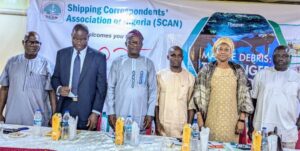
Stakeholders in Nigeria’s maritime industry have called for a dedicated law to combat marine debris, protect ocean health, and secure the future of coastal communities.
They made the call at the 2025 Annual Summit of the Shipping Correspondents Association of Nigeria (SCAN), on Thursday in Lagos, highlighting the urgent need for legislation to tackle the growing threat of marine pollution.
Marine debris, they noted, disrupts navigation, hinders port operations, pollutes coastlines, threatens tourism, harms coastal livelihoods, and poses serious public health risks.
The Guest speaker, Capt. Tajudeen Alao, President of the Nigerian Association of Master Mariners, decried the encroachment of marine litter on potential tourist sites, warning that Nigeria’s competitiveness in the maritime sector is at stake.
Represented by the association’s Second Vice-President, Capt. Jide Olugunwa, Alao urged the National Assembly to enact a law targeting marine debris. He proposed a fine of ₦5 million for individuals or entities caught dumping waste into Nigerian waters.
“The summit’s theme, Marine Debris: The Danger Ahead, underscores the urgency of protecting marine ecosystems and the livelihoods of coastal dwellers,” Alao said. “The growing scale of marine debris is not just an environmental issue—it’s a socioeconomic threat.”
Abubakar Dantsoho, Managing Director of the Nigerian Ports Authority (NPA), emphasized that marine debris endangers biodiversity, especially fish, marine mammals, and seabirds through entanglement and ingestion.
Represented by Capt. Femi Oyewole, Dantsoho said the NPA is actively supporting national and global efforts to combat marine litter. He described marine pollution as an escalating crisis requiring immediate action.
“NPA operates port reception facilities at all major ports in Nigeria, in full compliance with the International Convention for the Prevention of Pollution from Ships (MARPOL 73/78), particularly Annex V, which governs ship waste disposal,” he explained.
“These facilities handle a wide range of waste—plastics, food remnants, hazardous residues, sludges, and bilge water—safely and sustainably, discouraging illegal dumping and ensuring compliance with national and international standards.”
He also noted that the NPA routinely cleans marine litter and seaweed from port channels and quay areas to protect marine life and ensure smooth vessel operations.
Pius Akutah, Executive Secretary of the Nigerian Shippers Council (NSC), called for urgent clearing of inland waterways. Represented by Mr. Adeshina Sarumi, NSC’s Deputy Director of Monitoring and Enforcement, he said marine debris and wrecks continue to hamper water transport efficiency.
Similarly, the Managing Director of the National Inland Waterways Authority (NIWA), Mr. Bolaji Oyebamiji, stressed the importance of collaboration among stakeholders and increased education in coastal communities.
Speaking through NIWA’s Assistant General Manager, Mrs. Aisha Eri, he said marine pollution is a global issue that requires collective effort. She noted that NIWA has already launched a marine litter action plan involving multiple stakeholders, stressing the need for shared responsibility.
“While government agencies are making efforts, local communities must stop polluting the waterways,” she said.
The summit ended with a consensus that a comprehensive legal framework, public awareness, and coordinated stakeholder action are critical to preserving Nigeria’s marine environment for future generations.
Edited by Dada Ahmed.
